An NC electrical license is a state license for electrical contracting, and some cities add a license for individual electricians on top of it. The North Carolina State Board of Examiners of Electrical Contractors (NCBEEC) sorts contractor licenses into 10 classifications. Asheville adds its own layer: there, you need a journeyman license to work on your own under a licensed North Carolina electrical contractor.
This North Carolina electrical license guide is for apprentices building toward a journeyman card, journeymen ready to qualify a contracting business, and owners whose crews are licensing up. You'll learn which license fits your work, the hours each one needs and how to prove them. You'll also see the exam, the fees and what keeps a license active.

Do You Need an Electrical License to Work in North Carolina?
Yes. North Carolina requires a state license for electrical contracting, and the license level depends on project value. Under NCBEEC rules, when a project will be more than $60,000 but not more than $150,000, only an electrical contractor holding an intermediate or unlimited license is eligible to bid or do the work. Some cities also license individual electricians.
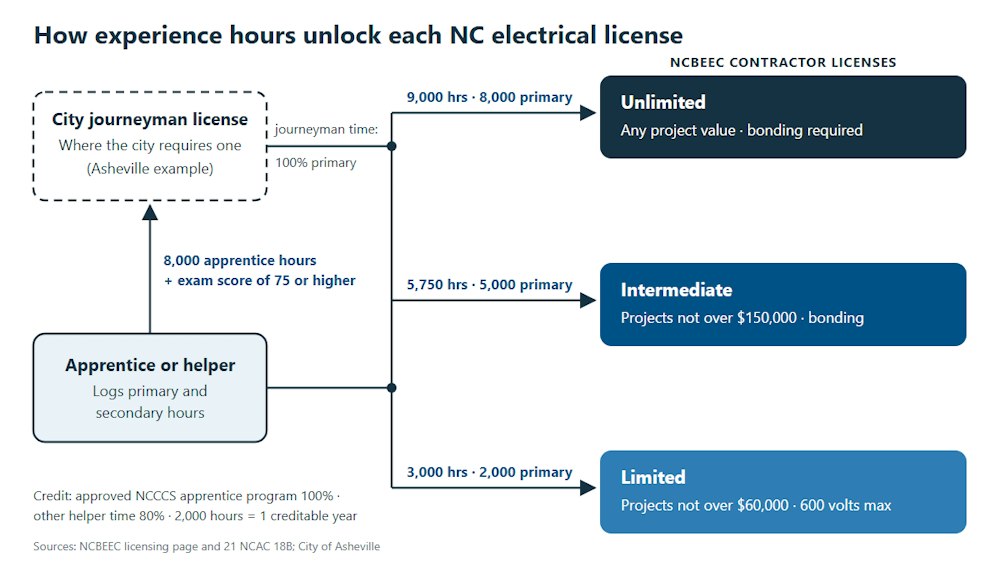
Asheville is one of those cities: it requires a journeyman license to work on your own under a licensed North Carolina electrical contractor. Applicants must work as an apprentice for at least 8,000 hours and keep documents that prove those hours. The city still gives the journeyman exam, and a score of 75 or higher earns the journeyman electrician license.
Keeping the card is simpler. An Asheville journeyman license lasts three years, always expires on June 30, and renews with 8 hours of NCBEEC-approved continuing education and a $30 renewal fee.
Before you plan your path, ask the inspections or development services office in the city where you work whether it issues a journeyman license, what it requires, and how it counts apprentice hours.
At the apprentice stage, a registered program adds structure. ApprenticeshipNC is North Carolina's state apprenticeship agency, and Registered Apprenticeship combines hands-on training with classroom instruction, structured wage progression and nationally recognized credentials. Training in a program approved by the NC Community College System also counts in full as NCBEEC secondary experience, which Step 2 explains.
Types of Electrical Contractor Licenses in North Carolina
North Carolina has 10 classifications of electrical contracting licenses. Three main contractor licenses are set by the largest single project each allows: Limited covers projects up to $60,000, Intermediate up to $150,000, and Unlimited any project regardless of value. The other seven are special restricted classifications that allow only a limited phase of electrical contracting work.
| License | Maximum single-project value | Annual license fee | Minimum experience |
|---|---|---|---|
| Limited | Not over $60,000, for equipment or installation of not more than 600 volts | $100 a year | 3,000 hours, at least 2,000 primary |
| Intermediate | Not over $150,000 | $150 a year | 5,750 hours, at least 5,000 primary |
| Unlimited | Any project, regardless of value | $200 a year | 9,000 hours, at least 8,000 primary |
The dollar limits apply to each single electrical contracting project. The rules also cover split work: if a project is subdivided into two or more contracts or subcontracts, the total value of the combined contracts awarded to one licensee must be within the total project value the license allows.
Intermediate and Unlimited licenses need one more item before you activate them: a statement of bonding ability. The board's laws and rules require applicants in those classifications to furnish either a bonding ability statement or a line of credit letter from a bank, savings bank, or savings and loan association.
Each of the seven special restricted classifications costs $100 a year, and a special restricted license does not authorize electrical contracting in general. Each one covers a narrow scope:
- Residential Dwelling (SP-SFD): single-family detached residential dwelling work. It requires 3,000 hours of experience, at least 2,000 of them primary, the same as Limited.
- Fire Alarm/Low-Voltage (SP-FA/LV): installing, maintaining, or repairing only low voltage wiring and directly related wiring.
- Plumbing, Heating and Air Conditioning (SP-PH): electric wiring or devices only as an incident to the licensee's plumbing, heating, or air conditioning business.
- Swimming Pool (SP-SP): swimming pool bonding work only as an incident to the licensee's business of installing, maintaining, or repairing swimming pools.
- Groundwater Pump (SP-WP): electric wiring only as an incident to the licensee's groundwater pump business.
- Electric Sign (SP-ES): electric wiring or devices only as an incident to the licensee's electric sign business.
- Elevator (SP-EL): electrical wiring only as an incident to the licensee's elevator, dumbwaiter, escalator, moving walk, or personnel hoist business.
How to Get an Electrical Contractor License in North Carolina: 6 Steps
The NC electrical contractors license process is six steps: choose a classification, document your experience hours, apply to NCBEEC for exam approval, pass the exam, activate the license, and renew it every year with continuing education. Step 2 takes the longest because it runs on hours you work, so start your records early.
Step 1. Choose the Electrical Contractor License Classification
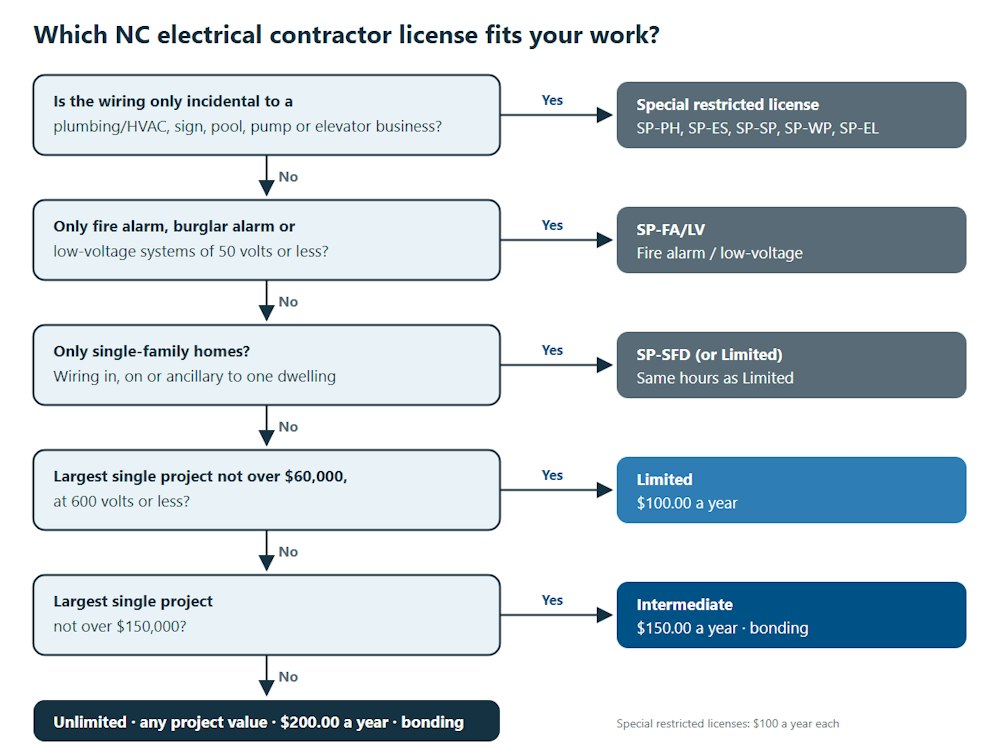
Start with the largest single project you expect to bid on, then pick the classification whose limit covers it. Wiring only single-family homes? Compare SP-SFD with Limited, since they share the same experience minimum. Planning to bid larger jobs over time? Pick the classification you're working toward now, because it sets the hours target for Step 2.
Step 2. Gain and Document the Required Electrical Work Experience
NCBEEC sorts experience into two types. Primary experience is work gained while engaged directly in the installation of electrical wiring and equipment governed by the National Electrical Code (NEC). Secondary experience is work or training related to that installation work. The Limited, Intermediate, Unlimited and SP-SFD classifications each need a minimum total, and most of that total must be primary.
Both types convert hours the same way: 2,000 hours equal one creditable year of primary or secondary experience. The kind of work decides which type your hours count toward and at what rate. Time as a journeyman electrician counts at 100 percent as primary experience. Apprentice time counts as secondary experience: training in a program approved by the NC Community College System counts at 100 percent, while other apprentice or helper time counts at 80 percent.
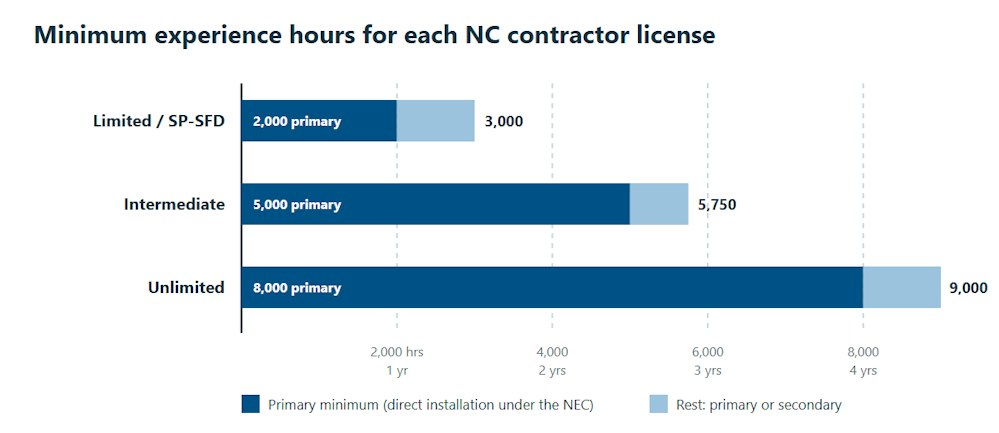
To estimate your own timeline, divide the total you need by the 2,000-hour creditable year and adjust for any time credited below full value. Helper time at 80 percent stretches the timeline, so check how your hours will be counted before you set an exam date.
You'll prove those hours on paper. NCBEEC provides Employer Statement Forms for verifying electrical experience, and the current versions are on the NCBEEC forms page. The statements are only as good as the records behind them, and reconstructing years of work from memory is slow and easy to get wrong. A simple routine keeps you ready:
- Log every shift by job and by task, not only total hours for the week.
- Note whether each task was direct installation (primary) or related work and training (secondary).
- Record who supervised you on each job, so you know who'll confirm your work later.
- Export or print your hours at the end of each month and file them with your pay stubs.
- Ask for employer statements when you leave a company, while the people who can verify your work are still easy to reach.
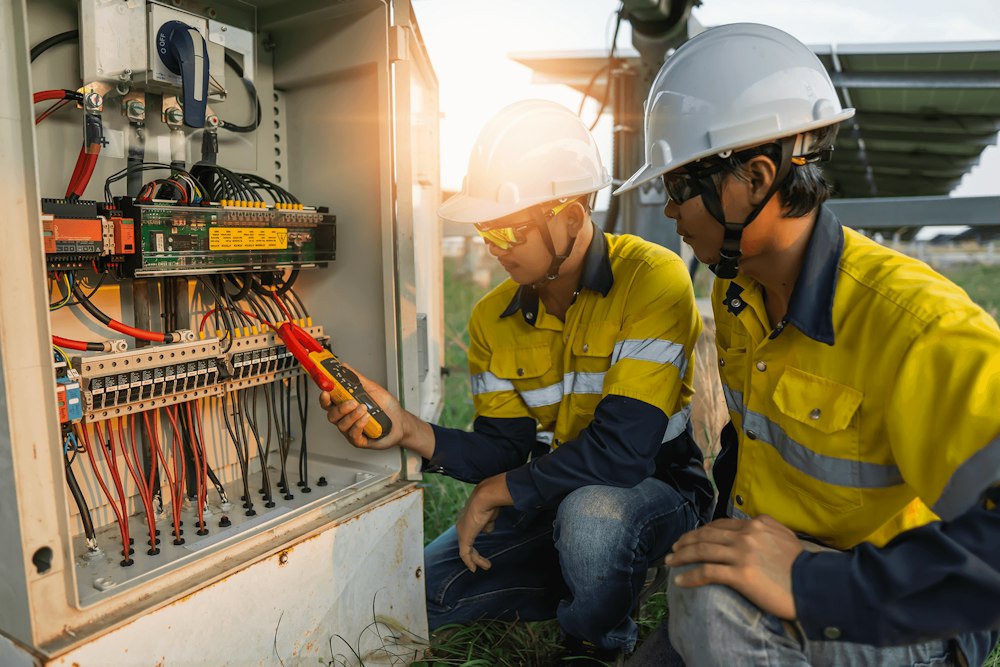
A digital timesheet takes care of the logging part of that routine. With time tracking for electricians, technicians clock in and out in the field from the ClockShark mobile app. Virtual boundaries around job sites remind crews to clock in when they arrive and clock out when they leave, and you can export timesheets into your payroll or accounting system.
In ClockShark timesheet reports, each clock-in logs the employee, job, task, and location. Reports filter an employee's time punches, jobs or tasks by date range or pay period, and you can download or print a crew time report as a PDF or use it in CSV format. That gives you and your crew a running record to work from when it's time to fill in the board's experience forms.
Step 3. Submit Your Examination Application to NCBEEC
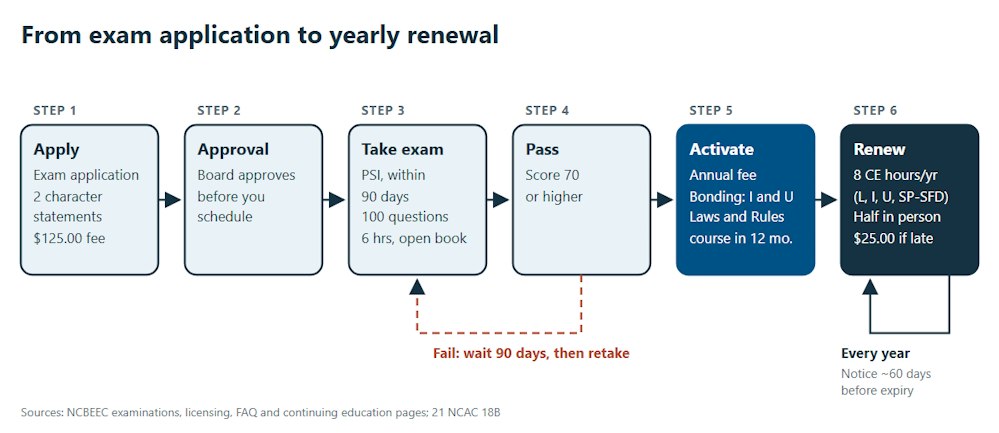
You must apply and get approval from the Board before you can schedule an exam. To meet the examination prerequisites, you must be at least 18 years of age and submit written statements from at least two people attesting to your good character with your application. Unlimited applicants also need statements from at least two people who know their electrical experience, attesting to their ability to supervise and direct electrical wiring work.
Send the completed application with the $125.00 examination fee. Download the current application and the Employer Statement, Character Statement and Supervise and Direct forms from the NCBEEC forms page each time rather than reusing an old copy.
Step 4. Schedule and Pass the NC Electrical Contractor License Exam
After approval, the Exam Authorization Period gives you a 90-day window to schedule and take your exam. Exams are computer-based and administered by PSI Services LLC, with testing centers in Asheville, Charlotte, Fayetteville, Greenville, Raleigh, Wilmington and Winston Salem.
The Limited, Intermediate and Unlimited exams each have 100 multiple-choice questions and 6 hours to finish. The exam is open book, so bring your NEC book, NFPA book, and NASCLA Business book. NCBEEC's study list includes the National Electrical Code (NEC) 2020 Edition and the National Fire Alarm Code (NFPA 72) 2013 Edition. You need a minimum grade of 70 to pass.
After a failed attempt, the board's rules say you must wait three months from the date of the failed exam before taking another exam in the same classification. Check the current study list before you buy books or tab your code book.
Step 5. Apply for and Activate Your Electrical Contractor License
After you pass, you apply to obtain and activate an electrical contracting license and pay the annual fee for your classification: $100 a year for Limited, $150 for Intermediate, and $200 for Unlimited. Intermediate and Unlimited applicants also furnish the statement of bonding ability described above.
Two rules shape how the business runs from day one. Each place of business of a licensed firm must have at least one listed qualified individual regularly on active duty to supervise and direct all electrical work. New qualified individuals also complete a free, four-hour Laws and Rules Course run by board staff, anywhere from 90 days before to 12 months after becoming a qualified individual. That course counts for 4 of the continuing education hours at the first renewal.
Step 6. Renew Your License and Complete Continuing Education
All NCBEEC licenses expire one year after the date of issuance. The board sends renewal notices about 60 days before expiration, and a $25.00 administrative fee applies to any renewal received after the license expires.
Continuing education is a yearly requirement, not a one-time study target. Qualified individuals in the Unlimited, Intermediate, Limited and SP-SFD classifications must complete 8 hours per year, and those in the special restricted classifications complete 4 hours per year. At least one-half the continuing education hours for each annual license period must come from in-person classroom or seminar attendance, so book live classes early in each license period.
Can You Transfer an Electrical License to North Carolina From Another State?
Yes, if your home state has a reciprocity agreement with NCBEEC. Through formal reciprocal licensing agreements, electrical contractors licensed by those state boards can get a North Carolina electrical contracting license without the written exams. The reciprocity page lists Alabama, Florida, Georgia, Mississippi, Ohio, South Carolina, Tennessee, Texas, Virginia, and West Virginia.
NCBEEC's laws and rules list one more state, Louisiana, among the reciprocal agreements currently in effect, so confirm with the board that your state's agreement is current before you apply. If your state has no current agreement, the board does not waive the exam, so plan to test.
What Happens After You Become a Licensed Electrical Contractor?
Once you qualify a license, your job shifts to keeping it and helping your crew earn theirs. Each place of business still needs at least one listed qualified individual on active duty to supervise all electrical work, and the license renews every year. Your electricians will also rely on you for the Employer Statement Forms that verify their experience.
In Asheville, a licensed journeyman can supervise up to two helpers or apprentices at a job site.
Mabry's Electrical Service, an electrical company, describes the problems its paper process created, including manual rounding, lost job sheets and buddy punching. The company reports that the buddy punching stopped after it adopted ClockShark. Accurate, job-by-job time records are also what your electricians need when they apply for their own licenses.
ClockShark also helps with the day-to-day side of licensed work. When a job has a form assigned, the app prompts workers to complete it before they can clock out, and required questions make sure crews answer the essential safety items on your compliance forms.
On the ClockShark Pro plan, job costing uses each employee's time and base pay rate to calculate tracked labor cost for a job, so you see what each project costs in labor.
Take the Next Step Toward Becoming a Licensed Electrical Contractor
The path to an NC electrical license is predictable once it's laid out: build primary experience, document it as you go, apply with your character statements, pass the open-book exam, activate the license, and renew it every year with continuing education. The hardest step to fix later is proving hours you worked years ago.
Pull the Employer Statement Form from the NCBEEC forms page now so you know exactly what your employers will confirm. Then start keeping that record today, whether you're an apprentice logging your first jobs or an owner tracking a growing crew. See how ClockShark fits your trade with time tracking for electrical contractors. Then start a free ClockShark trial and turn every shift into hours you can point to when it's time to qualify.
Frequently Asked Questions About North Carolina Electrical Licenses
How do I get my electrical license in NC?
Pick the NCBEEC classification that covers your largest single project, document the required experience hours, then apply with two character statements and the $125.00 examination fee. After the board approves you, pass the open-book exam inside the 90-day authorization window, pay your annual license fee, and activate the license.
Check with your city as well: Asheville, for example, requires a journeyman license to work on your own.
How many hours do you need for an electrical license in NC?
You need at least 3,000 hours of experience for a Limited license, 5,750 for Intermediate and 9,000 for Unlimited, under the NCBEEC rules. Most of those hours must be primary experience: at least 2,000, 5,000 and 8,000 respectively. Both primary and secondary experience convert at 2,000 hours per creditable year.
How long does it take to become an electrician in North Carolina?
NCBEEC counts 2,000 hours of experience as one creditable year, and a Limited contractor license needs 3,000 hours, including 2,000 primary, so your timeline is measured in the credited hours you log. Asheville requires at least 8,000 apprentice hours for its local journeyman license.
Apprentice and helper time counts as secondary experience, and helper time outside an approved program is credited at 80 percent, which adds to that timeline.
Does North Carolina require an electrical license?
Yes. NCBEEC licenses electrical contracting in 10 classifications, and its laws and rules make only Intermediate or Unlimited license holders eligible for projects over $60,000 and up to $150,000. Cities add a local layer too: Asheville requires a journeyman license to work on your own under a licensed contractor.
What are the requirements for an unlimited electrical license in NC?
An Unlimited license needs at least 9,000 hours of experience, including 8,000 primary, plus statements from two people who know your electrical experience, under the NCBEEC rules. Applicants also furnish a bonding ability statement or bank line of credit letter, pass the exam, and pay the $200 annual fee.
What is a limited electrical license in NC?
A Limited license lets you take on a single electrical contracting project worth no more than $60,000, with equipment or installation rated at not more than 600 volts. It costs $100 a year and requires at least 3,000 hours of experience, including 2,000 primary, under the NCBEEC rules.
Does North Carolina have a state journeyman electrician license?
No. NCBEEC's 10 classifications are electrical contracting licenses, not individual journeyman cards. Journeyman licensing comes from some cities instead: Asheville, for example, requires a journeyman license to work on your own under a licensed North Carolina electrical contractor, after at least 8,000 apprentice hours and an exam score of 75 or higher.
Is there a master electrician license in North Carolina?
NCBEEC does not issue a license called master electrician. Its 10 classifications are the Limited, Intermediate and Unlimited contractor licenses plus seven special restricted licenses. Asheville uses the term: its journeyman license is the second step in becoming a master electrician, so check your city's rules.
How much does an NC electrical license cost?
An NC electrical license costs the $125.00 examination fee plus an annual license fee of $100 for Limited, $150 for Intermediate or $200 for Unlimited. Special restricted licenses cost $100 a year. A renewal received after the license expires adds a $25.00 administrative fee.
What license do you need for low voltage work in NC?
Low voltage work in North Carolina falls under the Fire Alarm/Low-Voltage (SP-FA/LV) license, one of seven special restricted classifications that cost $100 a year. The license authorizes you to install, maintain, or repair only low voltage wiring and directly related wiring, not electrical contracting in general.