
How to hire subcontractors for construction is a repeatable sequence rather than a set of one-off decisions. Source candidates through channels you trust, prequalify them, compare bids on scope, contract in writing, onboard before they mobilize, then manage schedule, cost and payment. These ten practices cover that arc, from first contact to the trades you rehire.
Most of that risk stays invisible at the handshake. A sub's crew shortage becomes your schedule problem. The 2026 AGC workforce survey found that 42 percent of firms reported shortages of their own workers or their subcontractors' workers delaying projects.
Key takeaways:
- A signed subcontract does not decide whether someone is a contractor or an employee.
- A certificate of insurance shows only that a policy existed on the issue date. It does not make you an additional insured, and the carrier is worth confirming with your state insurance department.
- Vetting a sub's safety record does not discharge your own duty under OSHA's multi-employer citation policy.
Subcontractor Prequalification Pack: What to Collect and Where to Verify It
Gather these eight items before a subcontractor mobilizes. Each proves something narrower than it appears to, so the table separates what a document establishes from where you confirm it yourself. Verify at the source rather than accepting a forwarded PDF, because the gap between those habits is where most subcontractor disputes begin.
| Document | What it proves | Where to verify it independently | Collect it by |
|---|---|---|---|
| Signed Form W-9 | Legal name, entity type and taxpayer ID for year-end reporting | IRS Form W-9 | Before payment |
| Certificate of general liability insurance | That a policy existed on the issue date, and nothing more | The producer named on it, then the carrier through your state insurance department | Before mobilization |
| Additional insured endorsement | That your business carries cover under the sub's policy | Ask for the endorsement form number and read it. A certificate does not amend a policy | Before mobilization |
| Workers compensation certificate or state exemption | Whether you inherit the claim when a sub's worker gets hurt | Your state workers compensation agency, and the carrier through your state insurance department | Before mobilization |
| State or local trade license | That they hold a current licence for the scope you buy | Your state licensing board's online lookup, against the prime and subcontracting baseline | Before signing |
| OSHA inspection history | Federal or state-plan enforcement at their establishments | OSHA Establishment Search | During prequalification |
| Recordable injury rates | Injury frequency, not safety culture | OSHA public injury tracking data | During prequalification |
| Workers compensation mod letter | Loss experience against a 1.00 unity factor | The sub's carrier, read with the caveat in practice 3 | During prequalification |
10 Best Practices for Finding, Hiring, and Managing Subcontractors
These ten practices run in the order the work does. The first three cover finding and prequalifying subcontractors. The next three cover bidding, contracting and onboarding. The last four cover live jobs and paying reliably enough that good trades take your call next season, because subcontract management starts before the bid.
1. Build reliable channels for finding subcontractors
Most contractors stop at the trades they already know, then scramble when one of them turns the work down. Build four channels instead. Ask suppliers which crews pay on time. Work your local trade association chapter directories. Watch who does clean work on neighbouring sites. Search your state licensing board for firms licensed in the exact scope you buy.
Then work the channel most contractors forget, which runs inbound rather than outbound. On public work the Small Business Administration records that "any large business can post a notice of a subcontracting opportunity" through its prime and subcontracting programs, so qualified subs come to you.
2. Prequalify subcontractors before requesting or accepting bids
Prequalify before you price the work. Check six fronts before you spend time on pricing: entity and licence, insurance, workers compensation, safety record, financial stability and quality control. Use the pack above as the collection list.
Confirm capacity too, because a sub with the right licence and the wrong backlog still misses your dates. Cover what else runs in your window, the crew count they field, and who supervises when the owner is elsewhere. End the conversation on four signals. No written safety program. A refusal to name the insurance producer. A licence that excludes your scope. References only covering work half your size.
3. Verify financial stability, licenses, insurance, bonding, and safety
Look the firm up through your state licensing board rather than trusting a licence number on a letterhead. Confirm the legal entity name matches the name on the Form W-9 and on the insurance certificate.
Insurance is where the most expensive misunderstanding lives. A certificate of insurance proves a policy existed on the issue date. Only the endorsement extends the sub's coverage to you, so request the endorsement form number and read it, then check the carrier behind both through your state insurance department.
Search the firm through OSHA's Establishment Search under every legal name it uses, then pull recordable injury rates from OSHA's public injury tracking data.
Contractors read a 1.00 experience modification as a clean bill of health. NCCI's guide to experience rating explains that the mod applied to a policy "is either a unity (1.00) factor, a credit mod, or a debit mod," and that an employer receives that same unity factor when "it does not meet eligibility requirements for experience rating" at all. A small sub showing 1.00 sits below the rating threshold, which tells you nothing about their safety.
4. Compare bids based on scope, capacity, and value, not price alone
Treat a low bid as a scope difference until you prove otherwise. Put every bidder on the same scope sheet: what the bid covers, what it leaves out, whose material, whose equipment, whose cleanup, and what happens when the schedule moves. Read the exclusions twice, because that is where the change orders already sit.
Issue the scope in a document that separates the estimate from the committed number. If you do not have a format you trust, start from a template that prices subcontracted work with scope and exclusions spelled out and adapt it to your trade.
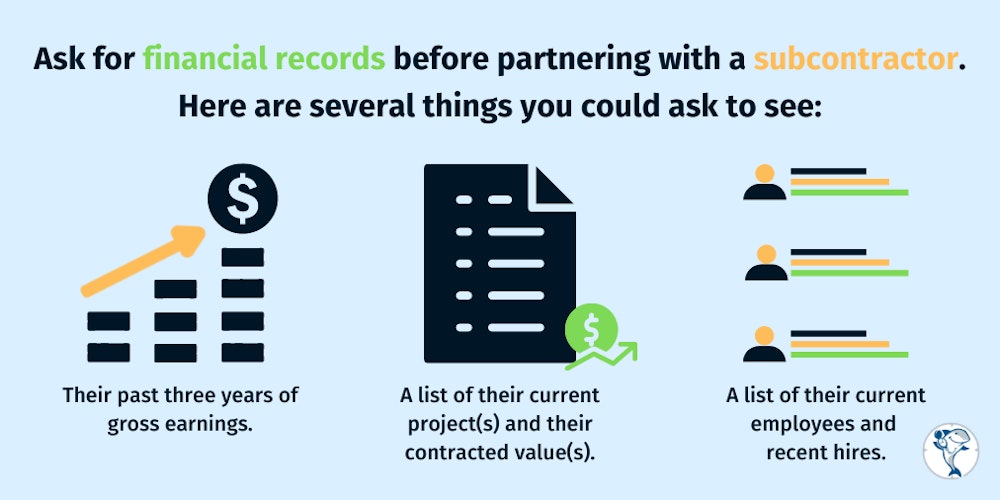
Documents from the subcontractor prequalification pack: Form W-9, certificate of insurance, workers compensation certificate and state trade license.
5. Put scope, schedule, payment, and responsibilities in writing
Keep scope, schedule, price, change-order pricing, insurance requirements, payment triggers, retainage, lien waivers and termination in the subcontract. Record the insurance limits, require the endorsement rather than a certificate, and set a date by which both arrive.
A signed subcontract does not make someone a contractor. Classification turns on how the working relationship operates, not on what the contract calls it. The Labor Department proposed replacing its independent contractor analysis in a rule published on February 27, 2026, with the comment period closing on April 28, 2026. That proposal rescinds the analysis currently sitting in 29 CFR part 795 and returns to an earlier economic realities test built around control.
Paused enforcement is not reduced exposure. The Wage and Hour Division said it would stop applying the 2024 Rule's analysis in FLSA investigations.
The proposed rule also says the 2024 Rule remains in effect for private litigation.
An investigator and a plaintiff's attorney apply different tests, and for most contractors the lawsuit is the larger risk. The IRS runs its own test, and its guidance on worker status states plainly that there is "no 'magic' or set number of factors" that settles it. For an unclear case, ask the IRS to decide using Form SS-8. This section gives general information rather than legal or tax advice.
6. Onboard subcontractors before work starts
Confirm the certificate, endorsement, workers compensation proof and signed subcontract are in the file, because onboarding is the last checkpoint where missing paperwork is still cheap. Then run the site orientation: access, hours, storage, waste, deliveries, the safety rules every trade follows, and how the sub reaches you when something changes.
Your safety duty does not transfer. Prequalification alone leaves this exposure open. OSHA's multi-employer citation policy allows more than one employer to receive a citation for the same hazardous condition. A controlling employer holds general supervisory authority over the worksite, including the power to correct violations or require others to correct them. You keep that duty no matter how carefully you vetted the sub.
7. Coordinate subcontractor schedules and jobsite dependencies
Keep one schedule published, show each trade what has to finish before they mobilize, and warn them early when a predecessor slips. Subs plan around the dates you give them. A sub who learns on Monday that the slab is not ready has already lost the crew.
Set predecessors and milestones before committing anyone to dates. Work from an example of how to sequence trades so each sub knows what has to finish before they mobilize.
8. Track progress, quality, hours, changes, and documentation
Check the written scope and the records rather than relying on conversations. Track what the sub bills against the contracted scope, how their hours land against your job budget, and how they absorb schedule changes, so overruns surface while the job runs.
Labor cost variance, rework rate and billing lag each surface an overrun early enough to act on, which is why it pays to track labor cost variance before the job closes instead of after.
Score every sub on the same five criteria.
| Criterion | What you record | Poor | Strong |
|---|---|---|---|
| Schedule adherence | Days late against the agreed milestone | Late, with no warning | On time, or warned early |
| Rework | Punch list items from their scope | Over 5 items | 0 to 2 items |
| Jobsite conduct | Behaviour against your site rules | Any breach | None, orientation followed |
| Change-order behavior | How extras surfaced and got priced | Surprise extras after the fact | Raised early, priced fairly |
| Documentation | Certificates, waivers and invoices on time | Chased twice or more | Arrived without chasing |
Rehire when a sub scores strongly on conduct and documentation, with at most one weak score elsewhere.
9. Keep communication clear and resolve problems early
Name one decision maker on each side. Put change-order requests in writing before the work happens, not after the invoice, and price them against the rates already in the subcontract. Raise problems on the day rather than at closeout, when the only thing left is money you still owe. A dispute two months later turns on what was written down at the time.
10. Pay reliably and build a subcontractor network worth keeping
Pay against the milestones and retainage in the subcontract, after an approved invoice and a signed lien waiver. Check billed hours against the record first, using a format that captures hours by job and cost code so an invoice meets real time rather than trust.
Gather the Form W-9 carrying the sub's taxpayer identification number up front so the year-end filing stays clerical. For tax years beginning after 2025, reporting for services begins at $2,000 per the IRS instructions for Form 1099-NEC.
Reliable payment builds the network. Contractors who pay on agreed terms get the first call when a good crew has a gap.
ClockShark banner: track crew and subcontractor hours by job for accurate labor cost reporting.
Common Subcontractor Management Mistakes to Avoid
Most subcontractor problems trace back to a handful of avoidable errors rather than to bad trades. Contractors accept a certificate as proof of cover, treat a signed contract as a classification decision, assume vetting transfers safety duty, and leave scope verbal. Each one costs little to head off and a great deal to argue about afterwards.
- Reading a 1.00 experience modification as a safety record rather than as a firm too small to rate.
- Agreeing change-order pricing after the work instead of before it.
- Leaving closeout paperwork until you are already holding final payment.
Use Better Systems to Manage Subcontractors across Every Job
Managing subcontractors across every live job gets harder as the count rises, because the records that matter live in different places. Hours sit in one system, certificates in another, change orders in email. Putting schedule, hours and job cost together turns subcontract management from month-end reconstruction into something you watch while work runs.
If you are still rebuilding job cost from paper at month end, see how time tracking for general contractors handles crew and sub hours before picking a system.
Frequently Asked Questions
Who is responsible for hiring subcontractors on a construction project?
The general or prime contractor hires subcontractors and holds the contract with them, while the owner holds the contract with the general contractor. That responsibility carries site duties too. OSHA's multi-employer citation policy allows more than one employer to receive a citation for the same hazardous condition.
Hiring the sub does not move your exposure onto them.
What should you ask a subcontractor before hiring them?
Ask for the legal entity name shown on their Form W-9 and licence numbers covering your exact scope. Then ask for a certificate of insurance plus the additional insured endorsement, workers compensation proof, OSHA inspection history, current backlog and crew count, and three references from jobs your size.
How do general contractors keep track of multiple subcontractors?
They run one schedule, one place for hours and job cost, and one document file per sub, then track each firm against its contracted scope rather than against memory. Sequencing matters most: a shared construction schedule your subs can actually work to prevents the collisions that cost days.
How do you evaluate subcontractor performance?
Score every sub on the same five criteria: schedule adherence, rework, safety incidents, change-order behavior and documentation timeliness. Verify claims at the source, for example through OSHA's Establishment Search, rather than relying on what you are told during the job.
Score each sub at closeout, while the detail is fresh.
How can contractors build a reliable subcontractor network?
Pay on the terms you agreed, give realistic lead times, share schedule changes early, and keep rehiring the trades that score well. Reliability runs both ways: the 2026 AGC workforce survey found 42 percent of firms reported shortages of their own or their subcontractors' workers delaying projects.
Crews that trust your payment terms hold dates for you.
Start with the Documents, Not the Handshake
Build the prequalification pack above and use it on the next sub you hire. Eight documents, each verified at its own source, is the cheapest risk control a contractor has.